
The integration of artificial intelligence (AI) into clinical workflows has fundamentally rewritten the rules of diagnostic medicine. Machine learning models regularly outperform elite human clinicians in specialized tasks, from identifying early-stage oncological abnormalities to predicting acute cardiovascular events. However, when these predictive algorithms operate as “black boxes”, that is, systems whose internal neural layers, weightings, and computational logic are too mathematically complex for human developers or clinicians to interpret, a critical vulnerability emerges.
When an opaque algorithm fails, misdiagnoses a critical pathology, and leaves a patient permanently injured, a chaotic litigation environment is born. It triggers a predictable cycle where lawyers blame vendors, vendors blame clinical users, and the judiciary struggles to apply centuries-old tort doctrines to adaptive, non-human code. We are operating in an institutional “blame vacuum”.
This briefing explores the shifting boundaries of legal responsibility, assessing how products liability, professional negligence, and emerging statutory regimes allocate financial exposure when the algorithmic black box fails.
Why Medical Negligence Cannot Capture Autonomous Failures

Historically, medical errors have been litigated through the prism of professional negligence (medical malpractice). Under traditional tort principles, a physician is held to a standard of care defined as the degree of care and skill that a reasonably prudent clinician in the same specialty would exercise under similar circumstances. Diagnostic AI completely disrupts this standard by introducing two deeply polarizing litigation realities:
- The Learner/Automaton Dilemma: If a physician blindly relies on an AI diagnostic recommendation that turns out to be wrong, plaintiff counsel will argue that the doctor breached his duty of care by outsourcing his independent medical judgment to an opaque machine. Conversely, if an AI is statistically proven to be highly accurate in detecting a specific lesion, and a human doctor overrules it based on intuition, that doctor risks being sued for negligence if the patient subsequently deteriorates.
- The Informed Consent Conundrum: Legally, a doctor must disclose all material risks of a procedure to ensure a patient can exercise true autonomy. However, due to the unexplainable nature of black-box models, a clinician cannot physically explain why or how an algorithm arrived at a specific diagnostic conclusion. This inability to trace the computational path prevents physicians from providing adequate risk disclosures, opening the door to informed consent lawsuits.
Because the clinician is often structurally incapable of verifying or auditing the black box’s underlying logic, treating the physician as the sole “learned intermediary” is an incomplete legal strategy.

Design Defects and the Informational Frontier
When fault cannot be fairly laid at the feet of the physician, the plaintiff must pivot to strict products liability claims against the AI developer or manufacturer. In strict product liability, a plaintiff does not need to prove the developer was negligent; he must only prove that the product was defective and unreasonably dangerous when it left the manufacturer’s hands. See Barnes v. Monsanto Company
Litigating an AI diagnostic tool under products liability yields distinct battlegrounds:
Manufacturing Defects vs. Algorithmic Drift
A manufacturing defect occurs when a specific item deviates from its intended design. Because software can be replicated perfectly, true manufacturing defects are rare. Instead, AI experiences “algorithmic drift” where a model continuously learns from real-world clinical data post-deployment, altering its own internal parameters.
If an AI degrades in accuracy over time due to this self-learning nature, developers will argue the defect did not exist when the software left their control, shifting liability to hospital networks for failure to properly monitor or retrain the system.
Design Defects and the Feasible Alternative Test
To establish a design defect, a plaintiff must demonstrate that the product’s risks could have been reduced or avoided by adopting a Reasonable Alternative Design (RAD). In black-box litigation, this introduces an extraordinary evidentiary hurdle.
The Plaintiff must prove that an inherently interpretable, “white-box” model (such as a linear decision tree) could have achieved the exact same high-stakes diagnostic accuracy as the complex, opaque deep-learning model.
Inadequate Warnings and Data Biases
A product can be deemed defective if it lacks adequate warnings regarding its known risks. In medical AI, the primary risk stems from data bias and unrepresentative training populations.
If a diagnostic algorithm is trained predominantly on clinical data from one demographic group, its diagnostic accuracy may drop significantly when deployed on patients of a different race, age, or gender. Failure by the developer to explicitly warn hospital networks about these localized performance drops constitutes a severe marketing defect.
Global Regulatory Responses and Legal Friction Points
As domestic courts struggle to adapt common law frameworks, international regulators are aggressively stepping in to codify AI liability boundaries.
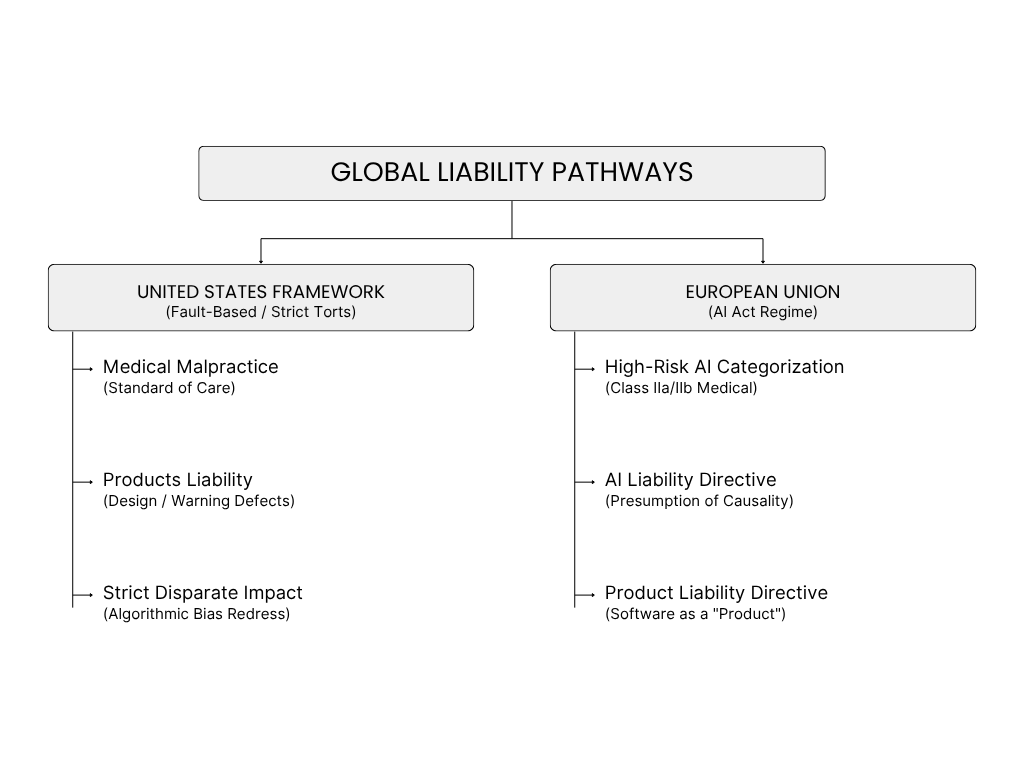
In the United States, the Food and Drug Administration (FDA) regulates AI diagnostic systems as Software as a Medical Device (SaMD). However, regulatory clearance (such as a 510(k) notification or De Novo classification) does not automatically grant developers immunity from state-level tort lawsuits.
Simultaneously, federal enforcement bodies are holding entities strictly accountable for algorithmic outcomes. The Equal Employment Opportunity Commission (EEOC) and the Federal Trade Commission (FTC) have firmly established that employers and tech developers can be held responsible for the discriminatory outputs and structural privacy failures of their automated tools. In the clinical space, this paves the way for strict civil enforcement when algorithmic bias leads to disparate health outcomes across protected patient classes.
The European Union has taken a starkly different, highly structured statutory approach through three interlocking pillars:
The EU AI Act: Categorizes AI-driven medical devices as “High-Risk,” forcing developers to mandate strict human oversight, thorough documentation, and rigorous explainability metrics before entering the market.
The Revised Product Liability Directive (PLD): Explicitly codifies software and AI models as “products,” granting victims the right to seek strict liability compensation if software updates or self-learning loops cause bodily harm.
The AI Liability Directive: Radically eases the burden of proof for plaintiffs by introducing a “presumption of causality.” If a plaintiff can prove that a high-risk AI system failed to comply with the transparency or safety requirements of the AI Act, courts will legally presume that the developer’s non-compliance caused the diagnostic injury, effectively shifting the burden of proof onto the tech firm.

Next Steps for Healthcare Providers and Developers
1. Governance and Allocation of Risk
Hospital systems and AI developers must craft robust enterprise risk frameworks. Under these models, the hospital assumes front-line liability for diagnostic failures, backed by strict contractual indemnification clauses that require developers to shoulder the financial burden if the failure is traced to a fundamental software defect.
2. Consider a “Verify-by-Default” Clinical Workflow
Take stock of current practices. If there is an organization-wide approach to treat AI diagnostic summaries as absolute clinical truth, explore whether it may be prudent to alter this approach. Ensure that clinicians act as an active layer of review rather than passive recipients of algorithmic outputs.
3. Implement an Internal Framework Governing AI Deployment
Consider introducing a framework establishing which clinical environments should and should not have autonomous AI tools enabled. For example, it may be decided that high-stakes, highly variable diagnostic departments (such as complex oncology or rare genetic pathology) should require mandatory dual-human review, keeping autonomous AI strictly in an advisory or secondary screening role.
4. Address Data Protection and Transparency Regulations
Seek necessary legal and regulatory advice to ensure compliance across all relevant jurisdictions, including considering whether a data protection impact assessment (DPIA) or an algorithmic auditing protocol is required under regional frameworks like the GDPR or the EU AI Act.
5. Monitor Performance and Algorithmic Drift
Set rigid data retention and performance monitoring periods for diagnostic tools. Hospital networks must continuously audit clinical outcomes to catch signs of performance degradation or algorithmic drift early, executing appropriate preservation and rollback protocols when errors are flagged.
6. Information, Education, and Training
Ensure that patients are formally notified and provide informed consent when a diagnostic workflow utilizes an AI tool. Further, train clinical staff and department heads on the legal consequences of relying on AI recommendations, making sure they understand the rules of professional negligence and know what categories of medical evaluation remain strictly human-driven.